
Riverside's Inauspicious Start
Riverside, the leafy, Frederick Law Olmsted designed suburb, celebrated by urban planners and landscape architects alike, is just as magical as its reputation implies. I know - I lived there for twenty-three years as a child and young adult. Far less magical, was the financial chicanery involved in its creation.

Following the 1864 opening of the CB&Q railroad, Chicago civic leader and socialite David Gage established a 1,600-acre equestrian farm and race track which he named the Riverside Farm. It was his custom to entertain the cream of Chicago society at his west suburban estate. A likely additional motive was to transform a part of his property into a residential subdivision.
In the mid-summer of 1868, Emery Childs, New York real estate developer met with Gage, and the two of them laid plans to create “the most pleasant, healthful, and desirable place of residence attainable anywhere . . . in all respects a model suburban neighborhood." Childs purported to have access to Eastern investment capital, while Gage supplied land. Childs acquired additional land, both east and west of the Des Plaines River, for his model community.
Landscape architects Frederick Law Olmsted and Calvert Vaux were retained to draw up a conceptual plan for the development, then continued on to implement the plan. Olmsted and Vaux made it clear that implementation of the plan would require a “large outlay of capital.”

In March, 1869, two companies, the Riverside Improvement Company and Riverside Gas and Waterworks Company, were incorporated, and authorized to issue $600,000 and $1,000,000 of capital stock respectively. Scarcely any stock was ever actually issued - $30,000 at the most. The “large outlay of capital” was financed instead with borrowed money – more and more and more borrowed money.

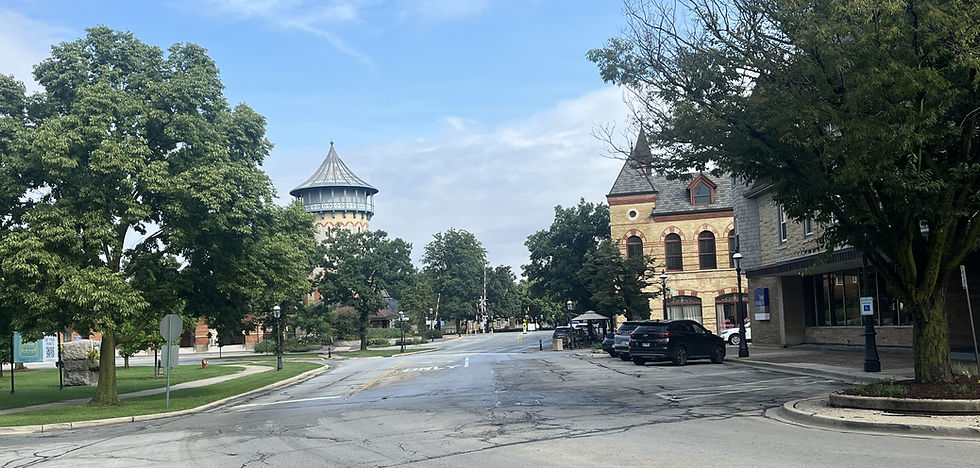
Two years of lavish spending of borrowed money followed. The Arcade Building, a new CB&Q train station, the Union Church, and the Riverside Hotel, were erected. The water and gas works, including the iconic water tower were established. Eleven miles of macadam paved streets were laid out. Park land was developed. 47,000 shrubs, 7,000 evergreens, and 32,000 deciduous trees were planted. Work was begun on a “grand carriageway” connecting Riverside to downtown Chicago. In 1869, Childs chartered a luxurious ten-car CB&Q train to bring visitors to the new development. Attendees toured the site in forty to fifty carriages that met the train. No expense was spared in development and promotion of the project.
Almost from the beginning, Olmsted and Vaux had misgivings. Scarcely three months after incorporation of the Improvement Company, Calvert Vaux described the project as a “kite flying affair.” Olmsted later referred to the project as “a regular flyaway speculation.” In April, 1970, ongoing financial and design disagreements led to Olmsted and Vaux to end their participation in the Riverside project.
Lot sale volume was disappointing. The project competed with Hinsdale and similar post-Civil War projects around the Chicago area. 1870 rumors that mosquitos bred malaria in Riverside diverted would-be buyers. Childs’ bombastic descriptions and “over-the-top” promotion methods like the chartered CB&Q train, led prospective buyers to believe that Riverside was too expensive. By the spring of 1871 only 200 lots had been sold.
Multiple issues of bonds swelled the debt. By October, 1871, outstanding bonded indebtedness had grown to $2,000,000 (53 million in 2025 dollars.) Early in 1872, another bond issue was attempted, one that would have allowed paying off the previous bonds. The new issue failed. Few investors wanted Riverside bonds. In order to keep the project afloat until lot sales improved, David Gage, in his role as City of Chicago treasurer, temporarily “borrowed” $400,000 from the city to purchase the otherwise unsalable bonds.
By mid-summer 1872, creditors and investors alike were nervous about Riverside’s debt financing and profligate spending. Two creditors sued the Riverside Hotel for $5,000 and $12,000 to compel payment of accumulated debt. Later, a butcher filed suit against the Riverside Hotel Company to recover $700 he provided in porterhouse steaks, tenderloin, lamb, liver, bacon and other food "which grace the table of a high-toned, semi-private hotel…”
The Chicago Daily Tribune opined that “The folly and injurious effects to the whole city of ill-advised real estate speculations, entered into without capital, and floated along from month to month, by kiting money obligations, is illustrated in the shower of suits, injunctions, judgments and executions that have fallen on the Riverside Improvement Company."
Childs hatched a new scheme. He acquired the dormant charter of the La Salle & Chicago Railroad and renamed it the Chicago & Great Western Railroad. He then incorporated the Chicago & Great Western Land Company, and transferred the Riverside Improvement Company assets (notably the land itself) to the new company. Childs arranged for a C&GW $8,000,000 bond issue, ostensibly for construction and equipping of the proposed railroad, but in fact it was intended to provide funding to retire all the Riverside Improvement Company and associated debt. The conveyed land, already pledged as collateral on the previous bonds, was also used as security for the C&GW bonds. Creditors sued the C&GW, compelling appointment of a receiver, while the shady and fraudulent financing activities were litigated.
On and on it went. An 1876 attempt at adjudicating the conflicting interests consolidated twenty different cases, involved twenty-four attorneys, and required a 103-page judicial
decision. Further litigation continued until 1891.
David Gage, unable to return his “borrowed” $400,000 to the City of Chicago was prosecuted in criminal and civil cases. He was indicted on charge of embezzlement, but acquitted. In the civil case, Gage was required to relinquish effectively all his personal assets, especially the remainder of the Riverside Farm that he had not made available to the Riverside Improvement Company. Litigation involving the Gage Farm land, as it came to be known, continued until 1933. It was 1964 before the City of Chicago disposed of the last of its confiscated Gage land.
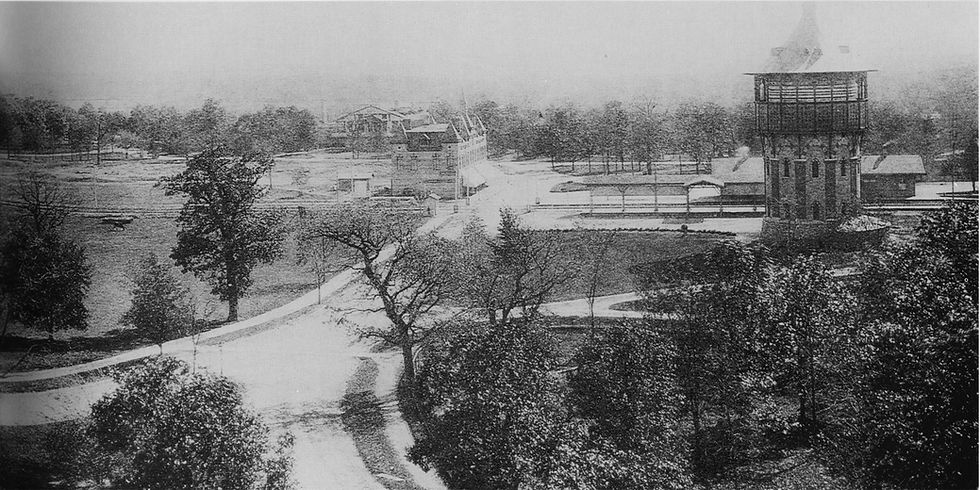
Riverside stabilized its day-to-day financing by incorporating as a village in 1875. Emery Childs emerged from the debacle relatively unscathed, returned to New York and resumed his real estate practice there until his death in 1886. Following Olmsted and
Vaux’s 1870 departure from the Riverside project, engineer and architect William Le Baron Jenney managed implementation of the Olmstead plan until the 1875 village incorporation. Jenney maintained his residence on Nuttall Road in Riverside until 1880, before relocating to the city. Jenney went on to renown as the developer of the technique of steel-frame office building construction and is remembered a the “father of the modern skyscraper.”
The "Grand Carriageway" to Chicago was never built. Land west of the Des Plaines River was sold at auction to satisfy Improvement Company debts. The once magnificent Riverside Hotel languished in increasing decrepitude until its destruction by fire in 1887. The Chicago & Great Western Railroad, Childs’ sham corporation established to park Riverside’s excessive debt, actually became a real railroad on Chicago’s west side, and continues to operate as part of the present-day CSX railroad system.
Reflecting on Riverside Improvement Company’s tangled web of financing practices and subsequent litigation, Land Owner Magazine characterized Emery Childs and others “as graceless a set of deadbeats as ever went unhung.” Yet despite its inauspicious beginning, Riverside eventually emerged as the magical place that Childs, Gage, Olmsted and Vaux had envisioned.


Comments